

Karl Marx, E. P. Thompson, and Hendrik Hartog on Custom, Law, and the Poor
* Basak Kus is Professor of Government at Wesleyan University, where she teaches historical and comparative political economy, public policy, and law. She is the author of Disembedded: Regulation, Crisis, and Democracy in the Age of Finance (Oxford University Press), and numerous articles on capitalism, state and democracy.
_________________________________________________________________________________________________________
On June 28, 2024, the US Supreme Court ruled six to three that municipalities may impose criminal penalties on unhoused individuals who sleep in public spaces.[1] The case arose in Grants Pass, Oregon, a city of roughly thirty-eight thousand people with an estimated five to six hundred residents experiencing homelessness on any given day, many of them accustomed to sleeping in public places.[2] In a sharp dissent, Justice Sonia Sotomayor wrote: “Sleep is a biological necessity, not a crime. For some people, sleeping outside is their only option. The City of Grants Pass jails and fines those people for sleeping anywhere in public at any time, including in their cars, if they use as little as a blanket to keep warm or a rolled-up shirt as a pillow. For people with no access to shelter, that punishes them for being homeless. That is unconscionable and unconstitutional. Punishing people for their status is ‘cruel and unusual’ under the Eighth Amendment.”[3]
The same year, the NYPD issued 9,376 summonses to street vendors in New York City, a sharp increase from earlier years.[4] Vendors face misdemeanor charges, monetary fines, and up to three months in jail for violations that include operating without a license. This would be understandable if licenses were available; they are not. The city has accepted no new applications for its general vending license waitlist since 2016.[5] Yet street vending is baked into the dough of New York City. It has been practiced by successive waves of immigrants for more than a century, from Jewish pushcart vendors on the Lower East Side to Puerto Rican piragua vendors in East Harlem and halal cart operators in Midtown. It provides income for the vendor, affordable food for the consumer, and constitutes an integral part of the streetscape.
These contemporary episodes belong to a history of conflict between custom and modern law, and the long war against the poor and the unpropertied. In the eighteenth and nineteenth centuries, as industrialization reshaped long-standing agrarian and craft-based systems and the state evolved from a feudal, patrimonial structure into a centralized and bureaucratic institution, practices through which subordinate classes secured access to resources necessary for survival—practices the poor had long understood as their customary rights—were increasingly drawn into legal contestation. A peasant gathering fallen and dead wood branches in the Prussian woods. A man taking a deer in Windsor Forest. A laborer’s pig loose on a Manhattan street. In the span of little more than a century, each of these—ordinary acts of subsistence, sanctioned by custom older than anyone could remember—was redefined as a crime or a public nuisance. The wood-gatherer became a thief, the hunter a capital offender, the pig keeper a menace to public order.
This was not simply a matter of legal doctrine changing with the times; law intervened directly in the structure of class relations. On one side stood landlords, forest owners, urban property holders, reformers, and state officials seeking to consolidate emerging capitalist conceptions of exclusive ownership, enclosure, and public order. On the other stood peasants, laborers, and the urban poor, whose claims to wood, animals, and streets were grounded in tradition, subsistence, and collective use.
This essay brings together three canonical accounts of these struggles over property, subsistence, and public order that have not previously been placed in conversation with one another: Karl Marx on the Prussian wood-theft debates, E. P. Thompson on the English Black Act, and Hendrik Hartog on pig keeping in New York City. The aim is not simply to offer histories of dispossession parallel to the contemporary episodes with which the essay opens, but to use these accounts as a lens through which to understand how class power operates through law and how that matters for social order.
What emerges from these accounts, to begin with, is that, although these episodes are separated by geography and political context, they reveal a shared structural dynamic. In each, practices essential to subsistence and rooted in long-standing custom were reclassified as crimes or public nuisances. In each, the reclassification ultimately served the interests of economic elites. In each, the state proved instrumental in translating elite interest into legal categories and presenting the new order as neutral and rational.
At the same time, viewed side by side, these accounts show that a broadly similar assault on customary claims took different forms across contexts. Marx’s Prussian case reveals a direct subordination of the legislative apparatus to propertied interests and, with it, a more openly coercive transformation. In Thompson’s account of the Black Act and the conflicts surrounding it, law was neither a neutral arbiter nor merely an instrument of ruling-class domination. It was a terrain of unequal contestation: shaped and enforced by propertied elites yet constrained by its own claims to justice and therefore available, however imperfectly, to those seeking to defend customary rights. Hartog’s New York case exposes a subtler mode of exclusion: courts did not simply prohibit customary practices but rendered the claims underlying them legally unintelligible by refusing to recognize the vocabulary in which they were expressed. In short, in the authors’ telling, the displacement of customary subsistence rights was not a uniform process but took shape through distinct legal means: direct legislative capture in Prussia, class domination mediated by appeals to the rule of law in England, and doctrinal erasure in New York.
As these cases also reveal, the process was neither seamless nor uncontested. The poor and unpropertied resisted with the means available to them. As Thompson explicitly notes, elites who wielded law as a weapon were compelled to confront the limits of subordinating it entirely to class interests, since law’s authority depended on claims to legitimacy, justice, and universality. In this sense, these accounts do not only destabilize the formalist tendency to understand legal outcomes as products of doctrinal logic largely autonomous from social relations, including class relations; they also complicate—most clearly in the work of Thompson and Hartog—the reductionist tendency to collapse law into little more than an ideological instrument of the ruling class. [6] As Thompson makes it clear, to say that law reflects class power is not to say that it is nothing more than an instrument of that power. Law is also a medium through which domination must be articulated, justified, and defended—and, in that very process, may be contested.[7]
Taken together, these histories point beyond themselves. Periods of socioeconomic transformation repeatedly give rise to struggles over who may claim access to resources and spaces, and law is one of the principal arenas in which those struggles are fought. Today, as in the past, the poor and the unpropertied often enter these struggles with claims grounded in necessity, use, and custom, while more powerful actors seek to redefine those claims as illegality, disorder, or nuisance. Recognizing this recurring pattern reveals that legal changes presented as neutral features of development, modernization, or public order frequently redistribute rights and burdens—shaping whose needs are recognized, whose practices are criminalized, and who is made to bear the costs of economic transformation.
At the same time, we must remember that law can serve class power only by giving it legal form, a process that both legitimizes domination and renders it contestable. The two centuries separating the Prussian woods from the streets of Grants Pass show that each new enclosure—of forests, streets, markets, or public space itself—must be justified anew through law. That process may allow propertied interests to prevail—and it often does—but it also leaves the terms of their victory open to challenge.
Gathering Fallen Wood in Prussia

In 1841–42, the Assembly of the Rhine Province of Prussia convened to consider a “Report on the Theft of Timber and other Forest Products”[8] (Bericht zum Diebstahl von Holz und anderer Forstprodukte) and debated legislation criminalizing the gathering of fallen and dead wood in forests. Karl Marx, a young journalist at the time, analyzed the proceedings to expose the ideological logic underpinning this transformation and published a series of articles between October 25 and November 3 of 1942. At stake, for Marx, was not a narrow question of forest regulation, but the reconfiguration and consolidation of property rights, the restructuring of state power, and the remaking of class relations under emerging capitalist conditions.[9]
For centuries, peasants had gathered fallen branches and other forest materials for heating and building. These practices, though they may have been initially understood as privileges granted, had over time hardened into customary use rights. Rarely codified in statutory law, they formed part of a lived normative order that structured rural survival. In Marx’s words, they expressed an “instinctive sense of right” among the poor— one that was both “positive and legitimate.” If such claims appeared only as custom and not as formal law, this was not because they lacked moral or historical validity. As Marx wrote, the poor had customary rights precisely because “they had no property.” Customary rights were, in other words, the juridical residue of exclusion from the formal legal order.
By the early nineteenth century, however, this customary regime increasingly conflicted with new economic and administrative priorities. Wood had become a valuable commercial commodity due to rising demand. The Prussian state,[10] acting through a newly professionalized forest administration, was in the process of “rationalizing” forest management.[11]
The 1841 amendment came at this juncture, seeking to eliminate the long-standing distinction between cut wood, clearly understood as private property, and fallen wood, which Marx described as the “alms of nature.” Both were now reclassified as objects of theft. According to Marx, this redefinition did not arise from concerns about justice, forest preservation, or public order. Rather, it reflected the material interests of forest owners. Legislative power had been weaponized in the service of private property, transforming the state into the “ears, eyes, arms, and legs” of the forest owner. What appeared in the Assembly as an abstract debate—that is, the issue being framed in the universal language of property, legality, and order, while systematically erasing the social context of subsistence— was, Marx argued, in fact class struggle in disguise.
The law not only criminalized a traditional practice but also allowed forest owners to collect fines directly from those convicted, transforming punishment into a source of private revenue—“capital for the forest owner.”[12] In doing so, the state did not merely protect property; it transferred its coercive power into private hands, which for Marx meant severing the “vital nerves” linking the state to the citizen. If the state, even in a single respect, he argued, “stoops so low as to act in the manner of private property,” it forfeits its claim to represent the universal or spiritual interest of society.
The analysis of the wood-theft debates marks a decisive moment in Marx’s intellectual development.[13] In exposing how the state’s legal machinery stripped the poor of their means of subsistence, he begins to approach an insight that would later become central to his mature thought: that economic relations structure social and political life, an insight he would soon crystallize, with Friedrich Engels, into a materialist conception of history.
Poaching Deer in English Forests
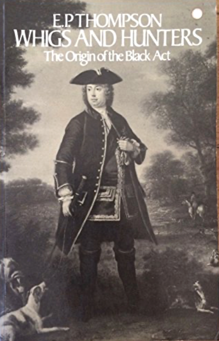
The eighteenth-century Black Act in England, in E. P. Thompson’s telling, offers a parallel case, though with its own distinctive contours.
In early eighteenth-century England, access to resources such as wood, game, and pasture in forests was understood not as acts of appropriation but as customary rights tied to subsistence and rooted in a long-established moral economy, although varying by parish membership, household status, and recognized need. Forest owners[14] often tolerated customary use. This was not out of benevolence, but because such practices were woven into the social fabric that sustained rural order and labor relations.[15] And the poor did not claim unlimited access to resources; instead, they operated within tacit but widely understood rules that differentiated between hunting for subsistence and hunting for sale, between seasonal necessity and opportunistic extraction. Violations of these norms were addressed through local sanctions such as shaming and exclusion long before they became matters of criminal law.
This equilibrium began to unravel with the rise of the Whig political establishment in the early eighteenth century. For the Whigs, many of whom had enriched themselves through the City of London and speculative finance, forests were increasingly reconceived as exclusive deer parks and lucrative estates. In the royal forests of southeastern England—Windsor, Hampshire, and Berkshire—intensifying commercial pressures and aristocratic leisure interests began to collide with long-standing local claims. This led to organized protest and poaching by groups known as the “Blacks,” so called because they often blackened their faces as disguises. Thompson shows that many of the Blacks were not the poor but in fact men of substance—yeomen, tradesmen, and even members of the local gentry—defending a traditional forest order against what they perceived as the predations of nouveau riche Whig appointees.
In 1723, Parliament enacted the Black Act, the culmination of a bitter social conflict over the use and privatization of forest resources. The Act created over fifty capital offenses, main ones being “that of hunting, wounding or stealing red or fallow deer, and the poaching of hares, conies or fish.”[16] If the persons offending were “armed and disguised, and, in the case of deer, if the offences were committed in any of the King’s forests, whether the offenders were armed and disguised or not,” these were seen as capital offenses.[17] Thompson notes that “At no stage in its passage does there appear to have been debate or serious division; a House prepared to debate for hours a disputed election could find unanimity in creating at a blow some fifty new capital offences.”[18]
For the Whigs, this was a matter of political emergency. What made it so was, Thompson noted, “the repeated public humiliation of the authorities; the simultaneous attacks upon royal and private property; the sense of a confederated movement which was enlarging its social demands … the symptoms of something close to class warfare, with the loyalist gentry in the disturbed areas objects of attack and pitifully isolated in their attempts to enforce order.”[19] In other words, he continued, it was the “displacement of authority, and not the ancient offence of deer-stealing, which constituted, in the eyes of Government, an emergency.”[20] By transforming long-standing practices into capital offenses, the Black Act did more than protect deer. It aimed to discipline rural populations, restrict access to common resources, and inscribe class hierarchy into the language of law.
Thompson’s analysis of the Black Act refuses two simplifying interpretations at once: on the one hand, what he called the “traditional ground of liberal academicism,” which he thought portrayed the eighteenth-century England as governed by a rule of law that attained, however imperfectly, impartiality;[21] and on the other, the Marxist standpoint, which rather schematically, he argues, sees the law as a part of a “superstructure” adapting itself to the necessities of an infrastructure of productive forces and productive relations[22]— that is, clearly and purely an instrument of the de facto ruling class. Instead, Thompson insists on law’s contradictory character, open to contestation and negotiation. Law-enforced class power. The eighteenth-century legislators acted to protect property and the propertied; that much is true. But law also had to appear just, universal, and autonomous to function.[23]
Its effectiveness even as an ideological instrument depended on its credibility. This appearance of justice sometimes restrained elites and provided ordinary people with a legal language through which they could contest power.
Keeping Pigs in New York
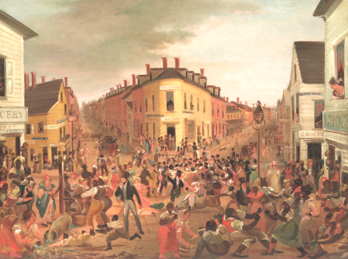
Across the Atlantic, in early nineteenth-century New York City, another conflict entangled law and customary practice: the keeping of pigs among working-class residents. Roaming pigs were an ordinary scene at the time; an estimated twenty thousand moved through the city’s streets.[24] “Letting one’s pigs run and fatten on the streets was an urban custom,”[25] as Hartog observes. Indeed, pig keepers “would have held, to use legal lingo, an easement over the streets, held by prescription or by customary right.”[26]
For poor and immigrant families, pigs were a vital resource. They “provided cheap food for the poor in winter,”[27] functioning as a form of subsistence that partially insulated them from market dependence, and as entities that prowled the streets, consumed waste, providing “a necessary public role”[28] in a growing city without centralized sanitation. Yet for urban elites, pigs increasingly came to signify something else entirely. As bourgeois norms of cleanliness, order, and respectability took hold, pigs were recast as “dangerous beasts,” “nuisances,” and embodiments of disorder— creatures that did not belong within an emerging vision of urban space organized around property values, commercial circulation, and public hygiene.
In Pigs and Positivism, Hartog uses the historical record surrounding pig keeping and municipal efforts to prohibit pigs in the streets to analyze what was, in essence, a class conflict over urban living.
The courtroom discussion in People v. Harriett (1819) made these tensions explicit. The prosecution reframed pig keeping as a threat to an abstract public, asking “whether the people, the citizens, generally suffer, or are liable to suffer, from hogs running at large.”[29] The defense, by contrast, grounded its argument in lived reality. Harriet’s lawyers insisted that labeling pigs a nuisance amounted to a direct attack on the way of life of the poor. “[A] great convenience, and almost an essential source on the score of provisions,” they warned, “would be taken from the poor or less opulent of the citizens by a conviction.”[30] If pig keeping were indictable as a nuisance, they argued, “the dandies, who are too delicate to endure the sight, or even the idea of so odious a creature, might exult; but many poor families might experience far different sensations, and be driven to beggary or the Alms House for a portion of that subsistence of which a conviction in this case would deprive them.”[31]
The mayor’s definition of public nuisance revealed the deeper logic at work. A nuisance, he explained, was “an offence against the public order and economical regimen of the state,” an annoyance to “the reasonable enjoyment of life, property, or common comforts of life,” even if no one’s health was affected.[32] Here, the notion of “public” no longer included the working population whose daily practices shaped urban life, but a social construct defined by the sensibilities, routines, and property interests of those with the standing to complain. The law did not deny subsistence needs; it rendered them irrelevant. As one advocate of prohibition bluntly asked, “It is said, that if we restrain swine from running in the street, we shall injure the poor. Why, gentlemen! must we feed the poor at the expense of human flesh?”[33] The answer was implicit: the poor were to be sustained through wages and markets, not through customary access to public space.
The Harriett decision ultimately held that unrestrained pigs in city streets constituted a public nuisance. Yet, as Hartog notes, for many ordinary citizens, the ruling had “little, if anything” in the way of practical effect, even though it remained on the books.[34] Law operated as a site of social negotiation, where legal authority remained plural, contested, and only unevenly enforced. City Council attempts to pass comprehensive pig-ban ordinances failed repeatedly in the years following the decision. In the few recorded prosecutions, fines were often nominal, and city authorities occasionally reimbursed owners for pigs seized by officials, implicitly acknowledging the legitimacy of the very practices the law had nominally condemned. Pig keeping continued in many neighborhoods well into the middle of the century.
As the nineteenth century progressed, a new cadre of municipal specialists— sanitary inspectors, planners, and police— actively tried to separate the keeping of animals from the functioning of the city itself. The violent “Piggery War” of 1859, in which municipal authorities demolished piggeries using armed police, marked the final suppression of the practice and the consolidation of bourgeois control over urban space.
The Harriet case, in Hartog’s telling, is distinctive not for customary practices coming under attack, which occurred in all three cases, but for something more insidious: the foreclosure of custom as a legally cognizable claim in American doctrine. “Neither the mayor nor the prosecutor ever suggested that pig keepers possessed any customary rights,” even though such rights had structured urban life for decades.[35] Custom, once “one of the normative weapons of the weak against the strong,” could not be articulated within American legal reasoning. In a recent paper,[36] Zug provides the rich doctrinal context for the “longstanding view that customary rights cannot be recognized in the United States.”
Conclusion
The emergence of modern legal systems in the late eighteenth and nineteenth centuries is often narrated as a story of rationalization, in which law appears as a civilizing force: replacing custom and tradition with formal reason, discretion with objectivity,[37] and repression and violence with restitution.[38] Yet this narrative obscures the extent to which modern law developed through concrete social conflict, particularly conflicts over access to resources essential for subsistence, competing claims to property, and disputes over what forms of rationality should prevail. Law did not simply evolve alongside social change; it actively participated in producing that change and was itself produced through it. As Pistor (2019) has argued in the context of property rights, courts played an active role in determining which claims would receive legal recognition and which would not.[39] We see this in the three cases discussed here as well: the wood-gatherer or the forest owner, the poacher or the aristocrat, the pig-keeper or the urban propertied class.
Contemporary debates over homelessness, street vending, and access to public space and resources echo the same structural logic that animated the conflicts over pigs, wood, and deer. The language may have changed; but the underlying tension has not. The law that criminalizes sleeping in Grants Pass, prosecutes a tamale vendor in Queens, or prohibits foraging in public parks is the progeny of past conflicts in which the moral economy of the poor was disrupted.
[1] City of Grants Pass, Oregon v. Johnson, 603 U.S. 520 (2024). Available at: https://www.supremecourt.gov/opinions/23pdf/23-175_19m2.pdf
[2] “The Policy Implications of Grants Pass v. Johnson,” FREOPP OppBlog, May 14, 2024. Available at: https://freopp.org/oppblog/policy-implications-grants-pass/
[3] Justice Sotomayor cited Robinson v. California, 370 U. S. 660 (1962).
[4] This was more than double the roughly 4,213 tickets issued in 2023, and five times as many tickets issued in 2019, before the pandemic prompted the city to temporarily reduce enforcement. The Department of Sanitation issued an additional 4,144, bringing the total across both agencies to over 13,000. See: Siewe and Talwar, “NYC Issued Over 10,000 Street Vendor Tickets,” City Limits, March 24, 2025. Available at: https://citylimits.org/nyc-issued-over-10000-street-vendor-tickets-confiscated-tons-of-food-in-2024/
[5] By May 2024, only 127 of the 890 supervisory food-vendor permits authorized under Local Law 18 had been issued in a city where the vendor population is estimated in the tens of thousands. See: Marcus Solis, “Street Vendors Rally: Hundreds Gather at NYC’s City Hall Calling for New Bill to Ease Licensing Process for Street Vendors,” ABC7 New York, August 15, 2024. Available at: https://abc7ny.com/post/street-vendors-rally-hundreds-gather-nycs-city-hall-calling-new-bill-ease-licensing-process-street-vendors/15189495/
[6] I use “formalist” and “reductionist” here as ideal types, marking the poles between which most serious accounts fall. For reference on the formalist pole, see Christopher Columbus Langdell, A Selection of Cases on the Law of Contracts (Boston: Little, Brown, 1871); Joseph Henry Beale, A Treatise on the Conflict of Laws, 3 vols. (New York: Baker, Voorhis, 1935); and, for influential reconstructions of this tradition, see Thomas C. Grey, “Langdell’s Orthodoxy,” 45 University of Pittsburgh Law Review 1 (1983) and Richard A. Posner, “Legal Formalism, Legal Realism, and the Interpretation of Statutes and the Constitution,” 37 Case Western Reserve Law Review 179–217 (1986); on the reductionist pole—the conception of law as an expression, instrument, or ideological legitimation of ruling class interests, see Karl Marx and Friedrich Engels, Manifesto of the Communist Party (1848); and, for a twentieth-century instrumentalist restatement, Ralph Miliband, The State in Capitalist Society (London: Weidenfeld & Nicolson, 1969).
[7] He writes: “… if we say that existent class relations were mediated by the law, this is not the same thing as saying that the law was no more than those relations translated into other terms, which masked or mystified the reality. This may, quite often, be true but it is not the whole truth. For class relations were expressed, not in any way one likes, but through the forms of law; and the law, like other institutions which from time to time can be seen as mediating (and masking) existent class relations (such as the Church or the media of communication), has its own characteristics, its own independent history and logic of evolution” Thompson, Whigs and Hunters, 376.
[8] The Assembly was one of eight provincial representative bodies within the Prussian monarchy, composed of deputies from the various “estates” (stände) from the city, the countryside, and the nobility. That body did not possess modern parliamentary sovereignty. It deliberated within a hierarchy whose ultimate legislative and executive authority was firmly concentrated in the hands of the Prussian monarch (at this time, Frederick William IV). The report was one piece of a larger legislative push, opened by the Forest Act of July.
[9] All quotations in this section are from Marx (1842), Debates on the Law on Thefts of Wood.
[10] Please note that by “state” I refer, as did Marx, to the Prussian central authority and legal order, not a unified German imperial government (which was yet not in place), and not merely the Rhine provincial administration.
[11] Similar enclosure movements, criminalization of peasant customary rights, and forest-theft legislation occurred across various German provinces not only in Rhineland at this time. However, the Rhineland was uniquely explosive because the collision between archaic noble privileges and modern capitalist legal codification was sharper there than almost anywhere else at the time in part because of Rhineland’s unique position- it had inherited from the French Revolution and the Napoleonic occupation a body of juridical reform centered on the free disposal of private property and the abstract equality of legal subjects, which broke with the older feudal traditions of Germanic law. On this issue see Daniel Bensaïd, The Dispossessed: Karl Marx’s Debates on Wood Theft and the Right of the Poor, ed. and trans. Robert Nichols (Minneapolis: University of Minnesota Press, 2021).
[12] In the context of the 1842 Rhine Province Assembly debates that Marx analyzed, the forests in question included both private and communal forests. Private forests were owned by private landed proprietors (the noble estates and the rising burgomasters). When Marx writes about the forest owners (the Waldbesitzer) he is referring to the private owners and the Rhenish nobility in 19th-century Prussia. For further discussion, see Bernard E. Harcourt, “Introduction to Marx 2/13: On Marx’s 1842 Articles on Thefts of Wood and Foucault’s 1973 Lectures on The Punitive Society,” The 13/13, Columbia Center for Contemporary Critical Thought, October 21, 2024, https://the1313.law.columbia.edu/2024/10/21/bernard-e-harcourt-introduction-to-marx-2-13-on-marxs-1842-articles-on-thefts-of-wood-and-foucaults-lectures-on-the-punitive-society/.
[13] Prior to his time at the Rheinische Zeitung, Marx’s thought was heavily influenced by liberal-rationalism and Hegelian-idealism, not yet through or material social structures. Practical journalistic encounters with hard material realities forced Marx to abandon this view. Althusser in ‘Marxism and Humanism’ first appeared in the Cahiers de l’I.S.E.A., June 1964.) identifies Marx’s tenure at the Rheinische Zeitung as the end of Marx’s liberal rationalism.
[14] In early eighteenth-century England Whig landed elite were the state. Following the Glorious Revolution of 1688, Parliament was the supreme sovereign power, dominated by the Whig oligarchy. When Whig elites enclosed forests, created deer parks, or criminalized local forestry rights, they were acting directly as the national legislature, the local magistracy, and officers of the Crown forests.
[15] All quotations in this section are from E. P. Thompson, Whigs and Hunters: The Origin of the Black Act (New York: Pantheon Books, 1975), Kindle Edition, unless otherwise noted.
[23]Thompson’s fullest statement of this dialectic is worth quoting at length: “We reach, then, not a simple conclusion (law = class power) but a complex and contradictory one. On the one hand, it is true that the law did mediate existent class relations to the advantage of the rulers; not only is this so, but as the century advanced the law became a superb instrument by which these rulers were able to impose new definitions of property to their even greater advantage, as in the extinction by law of indefinite agrarian use-rights and in the furtherance of enclosure. On the other hand, the law mediated these class relations through legal forms, which imposed, again and again, inhibitions upon the actions of the rulers. For there is a very large difference, which twentieth-century experience ought to have made clear even to the most exalted thinker, between arbitrary extra-legal power and the rule of law …” Thompson, Whigs and Hunters, 379–380.
[24] All quotations in this section are from Hendrik Hartog, “Pigs and Positivism,” Wisconsin Law Review (1985), unless otherwise noted.
[35] Hartog, 912.
[36] See Marcia Zug, “In My Defense, I Have None”: Taylor Swift, Indian Law, and a Re-Examination of Custom’s Inapplicability in the United States, 50 Harv. Envtl. L. Rev. [start page] (2026). Zug notes that “[t]he typical arguments against the doctrine of custom are well articulated in the 1905 case Graham v. Walker.” In this case, the Connecticut Supreme Court opined that the greatest impediment to importing the English doctrine of custom into American law is “America’s lack of a manorial system”; she quotes the court’s own statement of the point: “Feudalism never existed here. There were no manors or manorial rights.”
[37] Max Weber discusses this in his discussion of rational-legal authority and bureaucracy replacing traditional authority. See Max Weber, Economy and Society: An Outline of Interpretive Sociology, ed. Guenther Roth and Claus Wittich, 2 vols. (Berkeley: University of California Press, 1978).
[38] On repressive and restitutive law see Émile Durkheim, The Division of Labor in Society, trans. W. D. Halls (New York: Free Press, 1984)
[39] Katharina Pistor, The Code of Capital: How the Law Creates Wealth and Inequality (Princeton, NJ: Princeton University Press, 2019)