

Dr. Allie Goodman is the 2025-2026 Eisenberg Institute for Historical Studies Postdoctoral Fellow at the University of Michigan. She studies the social and political history of the 20th-century United States. Her work places legal history in conversation with the histories of the carceral state and of childhood and youth. Her current research examines Chicago’s Juvenile Court and connected systems of caretaking, welfare, and institutionalization. She is primarily interested in upending frameworks that study competing custody claims to instead center the voices and stories of impacted children and youth. She has additionally completed and supervised extensive public-facing research, including mapping projects for the University of Michigan’s Carceral State Project and podcasting for the University of Michigan History Department’s Podcast, Reverb Effect.
Last summer, I asked Professor Rebecca Scott for help. In the wake of her retirement, the department asked me to teach her class, “Histories of Law and Social Justice.” I also taught an additional course of my own design. Both courses incorporated politicized topics and as a historian teaching history classes, I hoped to engage students in a critical study of the past without simply paving over the rough terrain. But as a new instructor, I worried about getting it wrong and especially about student learning and engagement as institutions attempt to meet new challenges. So I asked a question that, upon reflection, was more reactive than instructive. I asked Professor Scott how she handled teaching contentious topics.
Professor Scott answered earnestly, advising that we “simply keep two feet firmly planted in the documents,” a method she credited to her colleague Jean Hebrard. A document-centered approach is not simply giving students the documents and seeing if they swim. Rather than teaching topics like a set of interconnected but ultimately segmented standalones, inquiry and document-centered teaching is a way of thinking and learning in which students engage deeply with documents by getting underneath them through context, close examination, and dialogue. So, as a junior scholar looking to develop a broader pedagogical approach, the question I should have asked was how to get students to engage deeply and thoughtfully with the past.
I initially hoped to jump right in — to give students context through secondary source reading and then teach methods of primary source engagement in class. However, as I was designing my syllabus, I was cautioned that students did not read. I heard stories about students relying on AI summaries and instructors assigning only ten pages of reading per week. So I cut about half of the readings I initially hoped to assign. But early in the semester, I realized that perhaps apathy was not the root of lacking engagement. First, students expressed disappointment about falling expectations. One student I spoke to said a lower bar felt discouraging; that falling expectations was the root of lacking engagement. Second, giving students secondary source reading supplemented with lectures was an ineffective way to teach historical context in my classes because many of my students were interested in the topics but did not know how to read academic history. So I pivoted. I devoted a few early classes to reading strategies. We reverse-outlined a few short articles in pairs and reflected together. We deconstructed other works by thinking about the process of writing; by trying to piece together an author’s research question, by viewing the argument as an answer to that question, and by thinking about what evidence and examples the author used to support that claim. And then I made a generic worksheet available that students could use for each subsequent reading. Teaching to think and learn meant giving students the tools to begin engaging with documents outside of class.
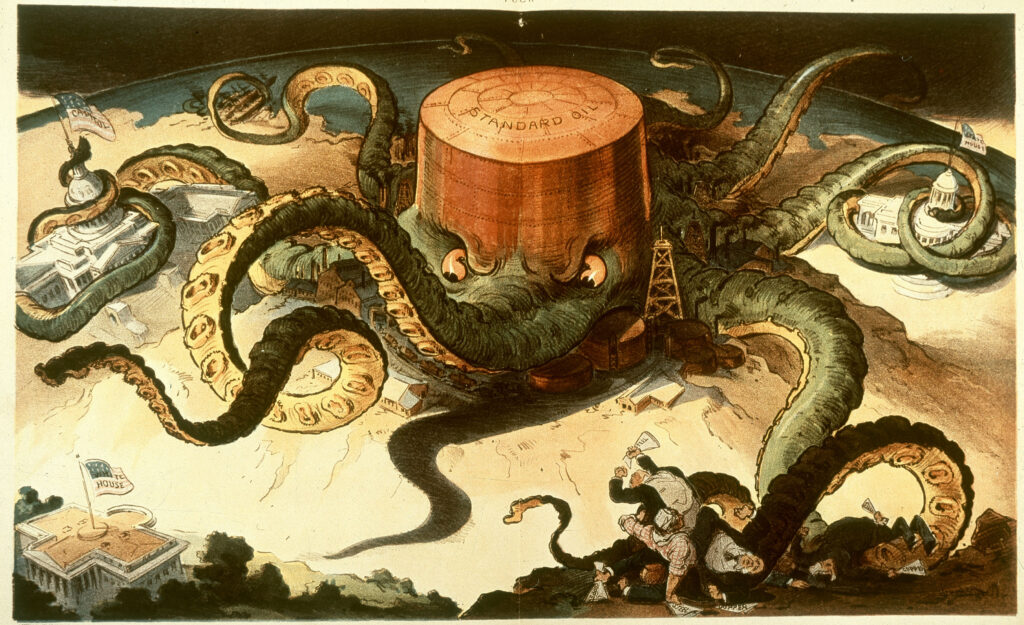
Once students were able to learn the context, I began teaching students how to engage critically with documents. We began by analyzing work together as a large group. For example, in one class, I showed the 1904 political cartoon, “Next!” In another, I assigned Lochner v. New York and we discussed excerpts in class. And towards the end of the semester, I showed the 1989 Hanna-Barbera political short, “D.A.R.E Yogi Bear.” In each, I introduced the “document” and then began with observational questions. What is going on here? What do you notice? What is drawn? What is written? What’s going on in this scene? What do the song lyrics say? Who are the speakers? What is being said? Then, I moved on to more dynamic questions that helped students, as the National Archives Document Analysis Educator Resource puts it “try to make sense” of the document. Who is the author? With what authority do they speak? Who do you think the audience is? Who are the documents primarily concerned with? Who is not shown? Why are the speakers saying what they are saying? And, always, I asked what other questions the documents raised for the students. Then, we situated the document in historical context that students learned from the reading. For example, when discussing “Next!” and Lochner, we talked about police powers, public utilities, and Progressive Era regulation to understand why states regulated some companies or industries but not others. Spending time answering these questions and digging into their own questions gave students more ownership over the process by prioritizing, validating, and rewarding their curiosity. It also reminded students about what they read and modeled how historians interrogate evidence and analyze documents.
The document-centered approach relies on student participation, which can be challenging. I encouraged and rewarded student participation by thoughtfully engaging with student inquiry. Without realizing it, instructors can shut down student participation by glossing over it as “expected behavior.” Of course, many of us put participation as a mark in our syllabus and give points for it at the end of the semester. I found it effective to reward participation and student curiosity as it happened in the midst of classroom discussion. When students asked questions, rather than reply vaguely with “great question,” answer, and move on, I tried to practice being more specific and intentional with positive reinforcement. I worked to repeat the question back to the class, where necessary to pull out essential nuggets of the question and keep discussion grounded in the documents, and direct the class to participate in answering the question. This helped validate student participation by demonstrating that student inquiry was worthy of class time and dialogue. I also worked to remember to reference back to specific students and their questions in subsequent classes. For example, when reading Lochner, a student understood the purpose of public regulation but was confused why legal historians are still so concerned with a case about bakeries, especially when the law was struck down. We talked about public health, but when we moved on to public utility regulation the following week, I referenced back to the student by name, reminded the class of her question, and used it as a segway to open discussion about unfair competition, the Federal Trade Commission, and the Clayton Antitrust Act. The students concluded that the courts were only one of many places to look for law and regulatory action during the Progressive Era. Positively reinforcing student engagement made it clear that I valued participation and engagement – that I valued and respected my students – which encouraged students to continue to participate, ask questions, and engage dynamically.
This participation was especially necessary as I moved students into small-group analysis. I found that document-centered approaches to teaching encouraged collaborative rather than adversarial conversation, which ultimately encouraged open critical engagement. Throughout the semester, I split students into small groups and gave each group either a different document about a related issue or a different section of the same document. I additionally gave each group a worksheet that parallelled the questions we asked and answered together as a class. DocsTeach, A National Archives Foundation educational resource, has sample documents and worksheets. While these are geared towards primary and secondary school students, they ask the fundamental questions that are critical to analysis at all stages of scholarship. These worksheets worked well to guide discussion. In one class, for example, I gave each group a different section of the Senate Comic Book Hearings of 1954. Each group discussed the subsection to answer the questions in small groups. Then, each group was responsible for presenting their section to the larger class. As a larger class, we discussed how the documents did – and did not – fit together. We reassembled conversations, took note of the impact of positionality, and learned how the intended audience impacts inquiry and writing. It mattered, for example, that this was a subcommittee about juvenile delinquency because the hearings maintained an underlying assumption that comics caused deviancy. After we pieced the documents back together, students reflected on larger trends. What key issues did these documents raise? Did they illuminate, fit with, or diverge from broader historical arcs? In this example, we talked about the Red Scare, nationalism, and inculcation in entertainment. Then we read excerpts from the Comics Code of 1954 together. Teaching history – and teaching a document-centered approach – requires students to view documents in dialogue, not debate. I asked students to practice this literally in my classrooms.
In “Histories of Law and Social Justice,” I included an in-class presentation as a companion to bluebook examinations for the midterm. I did this because I worried that not all students would be able to effectively demonstrate learning using bluebooks and I hoped to provide multiple pathways to excel. The presentations were also a logical next step in the scaffolding of a document-centered approach. Students replicated the analysis they did in their in-class small groups, but using their own research, untethered from class time, and with higher stakes. I also asked the non-presenting students to fill out note-taking worksheets during each presentation and they were expected to ask questions at the end of the presentation. This gave audience-members a chance to critically engage with their classmates and to practice critical listening. The presentations worked well – of course there are always issues with group projects, which I addressed using some of these strategies. But overall the students appreciated the opportunity to dig into a single event, do their own research, present their analysis to the class, and answer questions about their work. In my evaluations, several students said that they would have liked a second presentation alongside the final examination not only to offset the bluebook final, but also to demonstrate improvement from the first presentation.
Many faculty have moved to the bluebook examination and alternative forms of assessment due to founded concerns about academic integrity. While I did not assign a research paper in “Histories of Law and Social Justice,” I did assign research papers in my other class because they are still an effective way to teach and assess critical thought and documentary engagement. In general, I worked to align methods of assessment to course goals to give students the best chance to demonstrate learning. To do this, I scaffolded the papers, from crafting a research question to peer review of rough drafts. I also paired these component parts with craft and research workshops. Students learned, for example, how to write a research question through Question Formulation Technique or how to engage with archives with an archivist-taught visit to an archive on campus. I hoped students would walk away from this assignment and from this course being able to put documents in conversation and understand historical argumentation.
As I was most interested in students’ thought processes and assessing how they engaged the documents, I forbade using generative AI to complete the essays and all of the component parts. Of course, I did notice some students using generative AI at various (and honestly some deeply demoralizing) stages in the scaffolding. For example, I received several AI-generated annotated bibliographies. This was a problem, and not simply because it violated standards of academic integrity in my syllabus. Annotated bibliographies were a crucial early part of the scaffolding process because they ask students to succinctly summarize different documents and begin to think through how the documents spoke to each other and to their research questions. In our next meeting, in addition to a frank conversation about academic integrity, I explained to my students that this thought work was materially important to writing the research paper and to the course goals. To meet the standards of assessment, they needed to engage in inquiry at every phase.
Neither this conversation nor my approach to pedagogy solved the quest for academic integrity. And I understand why many instructors have cautioned against research papers. But research papers can work depending on approach and course goals. Despite – in some cases warranted – fears about how students crafted their assignments, many students also asked exciting research questions, engaged with archives (!), and wrote incisive, thoughtful papers. These papers were a natural progression of the document-centered approach because they tested whether students met the most fundamental learning objectives: how to engage thoughtfully and critically with research and with the past. Several students also approached me about majoring in history, saying they appreciated the chance to dig into the past through the documents. Teaching students to “get the documents to speak” is not only an effective way to teach history but an effective way to get students excited about history.
Candidly, I am not sure whether I would assign a research paper, a set of bluebook exams paired with presentations, or measure learning in an entirely different way in future iterations of “Histories of Law and Social Justice.” In lecture-heavy courses with many students, it may be more difficult to adequately scaffold a research paper. And I think the presentations worked to offset some of the inherent limitations of the bluebook. Some instructors have found success with alternative assessments such as oral examinations. But when I did not assign a paper, I missed the creativity that comes when students ask and answer their own research questions by “getting the documents to speak.” And asking how we get students to “get the documents to speak” and listen to what the documents have to say is, I believe, the fundamental tenet of teaching history.
In our initial conversation, Professor Scott cautioned against getting lost in an endless feedback loop of doom. My initial question about teaching “controversial topics” was reactive to the present moment rather than grounded in a timeless disciplinary sensibility. It missed the point of college pedagogy and learning in a history classroom. It can be so easy to get lost in the concerns of the moment, which are real and meaningful. And these concerns are real and meaningful not just to us as educators and academics but to our students as well. What I learned from Professor Scott – what was most effective – was to zoom out and refocus. I tried to understand what the essential skills of the historian were and how these skills mapped onto my goals as an educator. These goals were, yes, to teach students something about the past. But more broadly, I hoped to teach them how to engage documents they encounter – how to be critical readers and thinkers – whether they are reading Lochner v. New York or an opinion piece that’s promoted on their social media feed.
Our students are smart. They can learn how to get the documents to speak, how to listen to the voices of the past, and how to write sharp pieces that analyze and get underneath these voices in conversation. And, as I learned from Professor Scott, teaching students to get the documents to speak treats them as partners in learning. It gives them ownership over their learning outcomes by allowing them to puzzle through problems, experiment within known boundaries, and, I think most importantly, get comfortable asking questions rooted in critical thought.